
01
Sponsored Products
Control how the agreed products compete for demand.
Campaign structure, advertised products, automatic and manual targeting, keywords, product targeting, bids, placements, budgets, search terms and negative targeting.
Amazon PPC management Standalone or connected to wider account work
Amazon PPC management controls the agreed Sponsored Products, Sponsored Brands and eligible Display ads around a product objective and spending limit. An acceptable ACoS can still sit beside weak total sales, tight stock or poor contribution, so we read campaign results in their wider commercial context.
Example
The right target changes with the product's job. A lower ACoS is not automatically the correct answer.
01 / Business context
Advertising can help the right shoppers discover a product and show how they respond to searches, products and messages. It cannot make unavailable stock sell or compensate indefinitely for an unconvincing page, unsuitable price or weak offer.
When those conditions affect the advertising plan, we surface them. If the product page is the constraint, defined listing and creative work should be considered before more traffic. If several conditions need to change together, the Growth Partnership gives them one wider plan.
We pause or restrict expansion when stock is unavailable, a listing is suppressed, the offer is not being shown as the Featured Offer, the economics fail or conversion evidence points to a problem that bids cannot fix.
What the campaign result depends on
Can the shopper understand and choose it?
Is the proposition competitive and commercially workable?
Can the business serve the demand being created?
This shows whether the advertising result still makes commercial sense for the product and the business.
02 / Campaign scope
We do not add every available campaign type to make the account look busy. Each campaign needs named products, an objective, an approved budget and a review rule.
Sponsored Products
Campaign structure, advertised products, automatic and manual targeting, keywords, product targeting, bids, placements, budgets, search terms and negative targeting.
Sponsored Brands and Display ads
Brand, collection, video and suitable Display ads where the account is eligible and the available creative, products and budget support the work. Amazon Ads now uses the wider Display ads name; existing Sponsored Display campaigns continue to run.
Campaign control and testing
Clear naming and portfolio structure, approved spending limits, recorded changes and defined tests that do not continue indefinitely without a conclusion.
Ongoing optimisation
Search term and target decisions, bid and placement changes, budget allocation, query coverage and product level reviews at a cadence suited to the available data.
New images, video and other production are agreed before they enter the work. A large campaign rebuild, additional marketplace or DSP engagement is also scoped separately.
03 / Decision method
A campaign metric becomes useful when it is connected to the product's purpose and the conditions around it.
Agree whether advertising should protect contribution, extend relevant reach, support a launch, defend branded demand or serve another clear objective.
Use reliable product economics where available to understand what the product can support. Break-even ACoS is a boundary, not an automatic target.
Review the page, price, reviews, current Featured Offer status and stock before buying more traffic.
Material changes have a purpose and a review point, so the client can see what changed and what happened afterwards.
04 / Starting the work
We begin by defining ownership and the starting position. Existing campaigns are not rebuilt simply to make them look like ours.
If restructuring work is larger than the ongoing management scope, it is counted and agreed first.
Name the marketplace, products, campaigns, advertising types, media limit and the people responsible for listings, prices and stock.
Review the available campaign, search term, placement and advertised product records, plus the major business changes that affect interpretation.
Identify the most important budget, targeting, structure and coverage decisions before carrying out the approved changes.
Manage the authorised campaigns, monitor spend against the agreed limits and report completed work, constraints and decisions required from your team.
05 / Reporting context
Amazon Ads reporting
Agreed product context
Amazon attribution helps describe what happened after an ad interaction. It does not prove that every attributed sale was additional, that organic sales rose because of advertising or that profit improved.
06 / Level of responsibility
For a defined campaign set when capable owners remain responsible for listings, creative, pricing, stock and the rest of Seller Central.
Discuss standalone advertising →For an agreed range when advertising also depends on conversion, creative, offers, stock or operating work that you want us to coordinate.
Explore the Growth Partnership →For continuing responsibility across the agreed Seller Central account, including the routine operations and incident handling named in the proposal.
Explore full Seller Central management →07 / DSP and display
Before recommending Amazon DSP, we examine the audience, objective, products, marketplace, creative, measurement options, budget and likely role beside sponsored advertising.
If sponsored advertising is the more suitable use of the available budget, we say so. DSP is not automatically included in PPC management.
DSP readiness gate
If one of these is weak, the recommendation may be to wait or use the budget elsewhere.
08 / Access and spend
You fund media directly through Amazon. We work through named, client authorised access and stay inside the limits recorded in the proposal.
We manage and record the agreed targeting, bids, placements and budget allocation.
Your team approves the total commitment, product facts, final prices, stock purchasing and brand decisions.
If another team or provider remains involved, each campaign and material change has one named owner.
09 / Advertising evidence
The dashboards show reported spend and attributed sales. They do not establish incrementality, profit improvement or the effect of one campaign action.
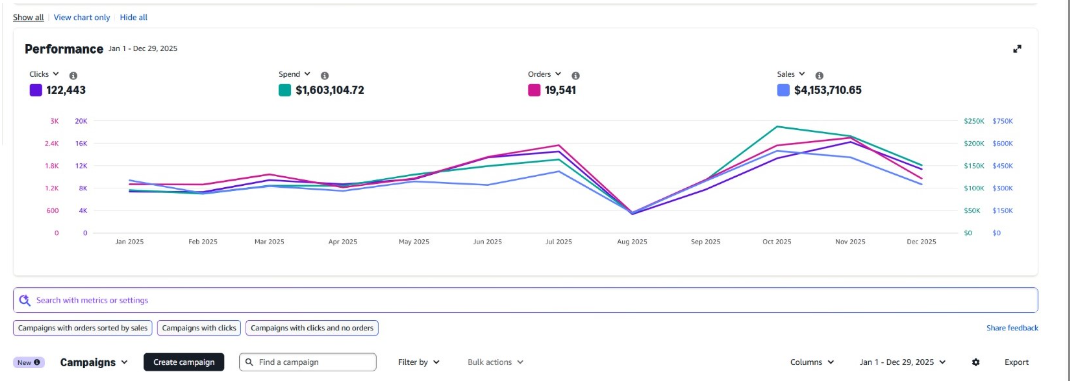
1 Jan to 29 Dec 2025
Client Seller Central account
The account has no prior advertising baseline or complete cost record. The paired Seller Central report showed $8.88m in total account sales for the same dates.
10 / Fit
A defined setup or rebuild may be enough when you do not need ongoing management. The Growth Partnership may fit better when advertising is only one part of the work required.
Standalone management is likely to fit when
We manage toward the agreed commercial objective and explain the decisions. A lower ACoS is not always the correct objective, and it cannot be guaranteed. Product economics, conversion, competition, stock and the job of each campaign affect the appropriate target.
You approve the media limit and pay Amazon directly. We allocate and adjust budgets within the authority recorded in the proposal. An increase beyond that limit comes back to you for written approval.
Yes, when the campaigns and access fit the agreed scope. We preserve useful history and change only what the plan supports. A large rebuild, inherited tracking problem or additional marketplace is assessed before inclusion.
Campaign setup using approved available assets can be included. New image, video or other creative production is counted and funded separately unless the proposal expressly includes it.
Only when its role, audience, budget, creative and measurement case are strong enough. We assess it separately rather than treating it as a compulsory upgrade.
ACoS divides ad spend by attributed ad sales, while ROAS divides attributed ad sales by spend. TACoS compares ad spend with total sales, including sales not attributed to ads. None of the three proves profit without reliable product, Amazon, fulfilment and operating costs.
No. PPC can bring relevant traffic, but it cannot by itself repair an unclear page, weak offer, an offer that is not currently selected as the Featured Offer, a suppressed listing or unavailable stock. Those conditions should be fixed or isolated before more spend is treated as the answer.
Start with the advertising job
Send the marketplace, approximate product and campaign scope, current spending range and the result or problem advertising needs to address. We will check whether standalone PPC, a defined project or wider growth work fits.
Describe your campaign objective